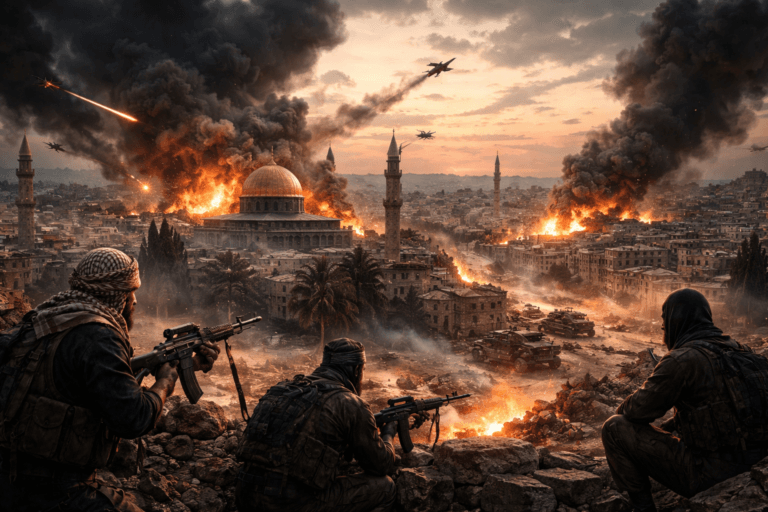
Washington, DC – Multiple intelligence and media sources have reported a state of high alert in the Middle East. This follows reports that senior US officials informed a regional ally that President Donald Trump may authorize a large-scale military strike against Iran. The attack is likely to occur as early as Sunday morning.
Objectives beyond the nuclear issue: a “decapitation” strategy
The DropSite News website quoted an unofficial advisor to the Trump administration and a former US intelligence official as saying that a potential attack would not be limited to targeting Iranian nuclear and missile facilities. It would extend to attempting to bring about broad political change within Iran. According to the source, the scenarios under consideration include focusing strikes on what is known as a “decapitation” strategy. This would be achieved by targeting the top leadership and centers of influence within the Iranian Revolutionary Guard Corps. The US administration believes this is a gamble that a crippling blow to the leadership structure would ignite internal protests that could topple the government. The report indicated that Israeli Prime Minister Benjamin Netanyahu informed US officials that Tel Aviv is capable of helping to push for the formation of a “pro-Western Iranian government” in the event of the collapse of the current regime.
Arab rejection of the airspace and Turkish mediation
In contrast, key regional powers have expressed strong reservations about any potential military action. Sources reported that Saudi Arabia and the UAE have officially informed Tehran and Washington of their refusal to allow the use of their airspace or territorial waters in any attack against Iran. Meanwhile, Turkey is leading intensive diplomatic efforts to convene an emergency trilateral meeting including the United States, Iran, and Turkey. These efforts aim to contain the escalation and avert a full-blown confrontation. From Istanbul, Iranian Foreign Minister Abbas Araqchi announced his country’s readiness to engage in negotiations. He also emphasized that “negotiations cannot take place under threat,” stressing that Iran’s defense capabilities are “not up for discussion.”
Tehran vows an “unlimited” response
In response, Iranian Armed Forces spokesman Brigadier General Mohammad Akrami escalated his warnings, asserting that all US bases in the region, as well as the countries hosting them, would be targets in the event of any attack. Analysts in Tehran believe that Iran’s policy of restraint over the past years has reached its end. Furthermore, they indicated that any future retaliation would aim to inflict significant casualties on US forces deployed in the region. US Secretary of State Marco Rubio estimates the number of these forces at approximately 40,000.
Official US silence and regional anticipation
In Washington, the US Central Command declined to comment on the circulating reports. The White House merely referred to previous statements by President Trump about a “large fleet” moving toward the region. With the official silence continuing and conflicting leaks persisting, the world’s attention remains focused on the coming hours, particularly early Sunday morning. This comes amid fears of a military escalation that could redraw the balance of power in the Middle East.