
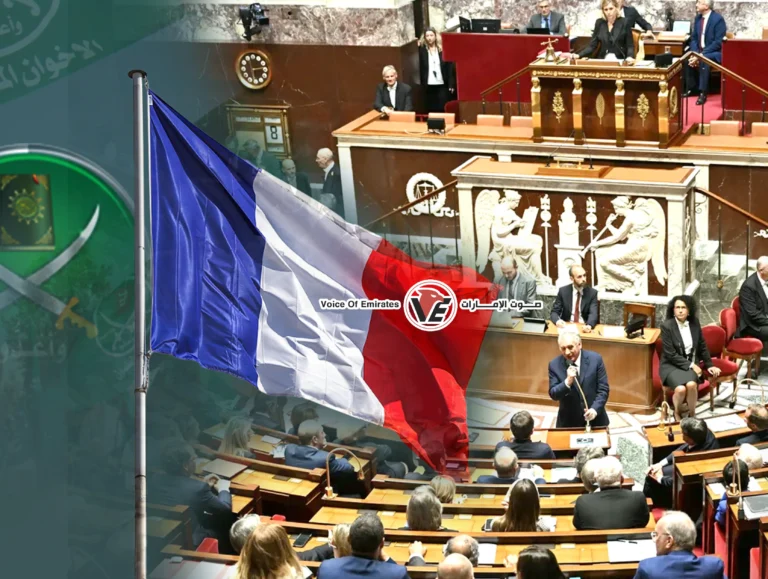
Paris, France – The French parliament, in a plenary session held on Thursday, approved a draft European resolution calling for the inclusion of the Muslim Brotherhood on the European Union’s unified list of terrorist organizations.
This move reflects a growing hardening of positions within France and Europe towards what are known as “political Islam” organizations.
The resolution was adopted based on Article 88-4 of the French Constitution, after being submitted by the Republican right-wing bloc,
which demanded legal recognition of the group’s political and ideological nature and its incompatibility
with the principles of democracy, secularism, and the rule of law upon which the European Union is founded.
European position
The plenary session was preceded by discussions within the European Affairs and Foreign Affairs Committees of the National Assembly before its final approval.
The decision is based on multiple legal and international references, most notably UN Security Council Resolution 1373 of 2001 on combating terrorism,
as well as EU treaties and the European Convention on Human Rights,
and the Common European Position of December 2001 on the application of counter-terrorism measures.
The text asserts that the Muslim Brotherhood represents a transnational ideological network operating
in several European countries through educational, religious, and charitable fronts, with the aim of building
what the resolution describes as “parallel societies” and seeking institutional influence and infiltration within those societies.
legal measures
It also cites French and European security and intelligence reports that have warned of
the activities of networks linked to the group, some of which receive external support.
The resolution clarifies that several countries, including Egypt, the UAE, Saudi Arabia, and Russia, have already designated the Muslim Brotherhood
or its affiliates as terrorist organizations, while European countries, such as Austria, have taken legal measures to restrict activities related to “political Islam” since 2021.
The resolution is to be submitted to the European Union institutions,
where it will be discussed by the European Commission and the European Council.
If adopted, it will be implemented in all EU member states, including stricter controls on funding
and enhanced intelligence and judicial cooperation to counter what Paris considers a transnational ideological and security threat.