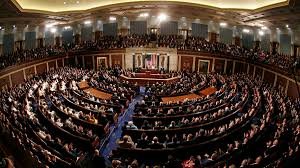
Washington, United States – On Sunday evening, the US Congress passed the National Defense Authorization Act (NDAA), which included a crucial provision to lift sanctions imposed on Syria under the “Caesar Act”.
This development comes about a month after Syrian President Ahmed al-Sharaa’s visit to Washington and his meeting with US President Donald Trump at the White House. The complete lifting of US sanctions was a primary objective of the visit.
Repeal mechanism and Congressional report
The bill requires the US president, or their representative, to submit a report to Congress every six months for the next four years. This report aims to assess the performance of the Syrian government. “Concrete actions” must be taken on several key issues, including:
Counterterrorism: Taking concrete steps to eliminate the threat posed by ISIS and other terrorist groups. This includes al-Qaeda and its affiliates. Furthermore, working in partnership with the United States is essential to prevent the resurgence of ISIS.
Foreign fighters: Remove, or take steps to remove, foreign fighters from senior positions in the Syrian government. This includes security and civilian institutions.
Minority rights: Respecting the rights of religious and ethnic minorities in Syria, guaranteeing freedom of worship and belief, and providing fair and balanced representation in the government and parliament.
Military action: Refrain from unilateral and unjustified military action against its neighbors, including Israel. Progress must continue toward international security agreements.
The SDF and the integration of forces: Taking concrete and credible steps to implement the March 10, 2025 agreement negotiated between the Syrian government and the Syrian Democratic Forces (SDF). This includes measures for integrating security forces and political representation.
Combating illicit financing: Taking effective steps to combat money laundering, terrorist financing, and the financing of the proliferation of weapons of mass destruction. Furthermore, the government must not finance or assist any of these activities.
The non-classified report, along with a classified supplement if necessary, must be submitted to the relevant committees in the House of Representatives and the Senate. This must be done within 90 days of the law’s enactment and every 180 days thereafter.
The end of the “long and fierce battle”
In a related context, the head of political affairs at the Syrian American Council, Muhammad Alaa Ghanem, confirmed “the completion of work on the articles to repeal the Caesar Act and the finalization of the article repealing it in its final form in the final version of the Department of Defense (Pentagon) budget, which was agreed upon by the Senate and the House of Representatives.”
Ghanem stated in a post on Monday that “the Caesar Act will be repealed before the end of this year, and the repeal is unconditional.” He added that “this means eliminating the mechanism for automatically and immediately reimposing the Caesar Act, especially if the Syrian government fails to comply with a long list of binding conditions within just eight months.”
The US Treasury Department announced on November 10, following a meeting between al-Sharaa and Trump, that it was extending the suspension of sanctions imposed under the Caesar Act for 180 days. It also clarified that the full lifting of those sanctions was contingent upon congressional approval.
Future prospects for the “final round of sanctions”
For his part, the Governor of the Central Bank of Syria, Abdul Qader Hasriya, expressed his expectation that the sanctions would be lifted by the end of 2025. This would bring an end to the “final phase of sanctions”.
He said last Thursday that the cancellation “will reassure potential correspondent banks about dealing with Syria.” He also noted that Syria is working to update its anti-money laundering and counter-terrorism financing regulations to provide additional assurances to international lenders.
The Caesar Act, imposed in 2019, is considered one of the harshest sanctions imposed on Damascus. It targets individuals, companies, and institutions linked to former Syrian President Bashar al-Assad and prohibits any country or entity from engaging in financial or economic transactions with the Syrian government or supporting it.