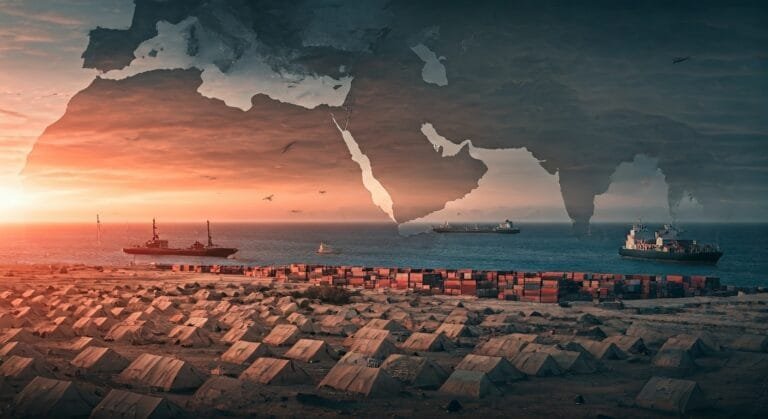
Cairo, Egypt – The Middle East is not just a map on a news screen, but an open stage for conflicts. A region home to more than 450 million people and containing nearly half of the world’s oil reserves lives on top of a volcano. Almost every country carries the burden of a crisis: a war here, tensions there, and millions caught between displacement, poverty, and waiting.
Wars That Never End
Gaza alone is enough to summarize the scene. From October 2023 to mid-2025, more than 62,000 Palestinians have been killed, and nearly 70% of the infrastructure destroyed. Over 1.9 million displaced people search for shelter they cannot find.
In Yemen, conflict continues to trap the population: 21.6 million people need humanitarian aid—seven out of every ten citizens. Syria fares no better, with over 500,000 killed since 2011 and nearly 14 million displaced or refugees. It’s as if time stopped there more than a decade ago.
Economies on the Brink
In the Gulf, oil prices above $80 bring some surplus. But elsewhere the picture is bleak: Lebanon is drowning in debt exceeding 170% of its GDP, and the lira has lost more than 95% of its value. In Sudan, displacement has exceeded 10 million people, putting the country at the top of humanitarian tragedies. Egypt faces inflation approaching 35% and mounting pressure on the pound.
Endless Interventions
Events here don’t move on their own. The United States pumps more than $3.8 billion annually in military aid to Israel and keeps tens of thousands of troops in the region. Russia consolidates its presence in Syria, while China buys influence through investments exceeding $250 billion since 2013. The region has become a chessboard where every player moves their pieces at the expense of the people.
Security on the Edge
It’s enough to note that more than 20% of the world’s oil supply passes through this region daily. Seventeen million barrels cross the Strait of Hormuz, and 12% of global trade moves through the Suez Canal. Any disruption in these routes means billions in losses within hours. With Iranian-Israeli tensions and operations in the Red Sea, regional security remains as fragile as glass.
The People: The Perpetual Victims
All these figures point to one reality: the human being is the first loser. Youth unemployment exceeds 25%, and more than 50 million Arabs live below the poverty line. Nearly half of the region’s population is under 30, yet the future awaiting them hangs between weapons, blockades, and deals that disregard their dreams.
Where To?
The question has been asked for years: Where is the Middle East heading? The truth is that the picture is complex, and interests are intertwined. What we do know for certain is that wars consume wealth, waste lives, and indefinitely delay development.
No one may have the full answer now, but one thing is clear: there will be no stability without a just settlement, no development without ending conflict, and no future without people.