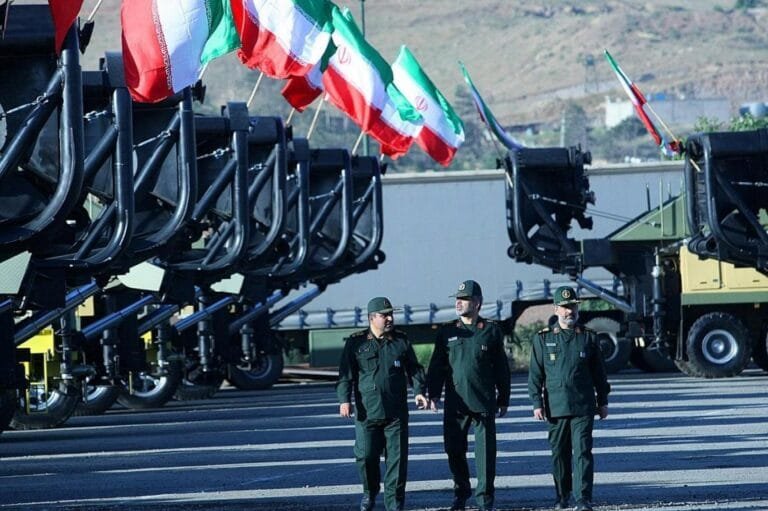
London, Britain – Well-informed military sources have revealed a dangerous trend within the Iranian military establishment. The Islamic Revolutionary Guard Corps’ air force is working on developing “unconventional” warheads. These developments include biological and chemical agents for mounting on long-range ballistic missiles.
The program accelerated and platforms were deployed eastward.
Sources told Iran International that these activities have accelerated significantly in recent months. This coincides with the relocation of missile launchers to the eastern regions of the country. These moves come amid escalating regional tensions and growing fears in Tehran of a direct conflict with Israel and the United States.
According to the report, the program focuses on two main axes. The first is improving ballistic missiles to be capable of carrying chemical and biological warheads. The second is upgrading the guidance systems and developing the control systems associated with these weapons to ensure their effectiveness in emergency situations.
“Complementary deterrence” and survival strategy
In response to questions about Tehran’s violation of international agreements prohibiting chemical weapons, a well-informed source explained that the Iranian regime now views potential attacks as an “existential threat.”
The source added: “There is a perception among decision-makers that the use of unconventional weapons is justified in cases of extreme necessity. This aims to increase the cost for the other side and prevent the regime’s collapse.”
The Revolutionary Guard describes these capabilities as a “complementary deterrent” that works alongside its conventional missile program. This aims to create a new balance of power in the region.
Tight Western intelligence surveillance
In a related development, previous reports confirmed that Western intelligence agencies have detected unusual movements by the Islamic Revolutionary Guard Corps’ Aerospace Force. These agencies are currently tracking command and control signals and logistical movements associated with this force. This comes amid Israeli warnings to Washington that these exercises could be a prelude to a surprise attack.
International repercussions and red lines
Military analysts believe that confirmation of these reports would fundamentally alter the rules of engagement in the Middle East. This could lead to a strong international response, including unprecedented sanctions and intense diplomatic and military pressure. Despite Tehran’s continued denials of seeking unconventional weapons, the ongoing development of its ballistic missiles’ range and accuracy remains a major concern for the international community.
On the media front, Chinese state media outlets have begun suggesting that Iran’s increased focus on its missile program represents a new “red line” for Israel. This raises the specter of a potential escalation in the region.