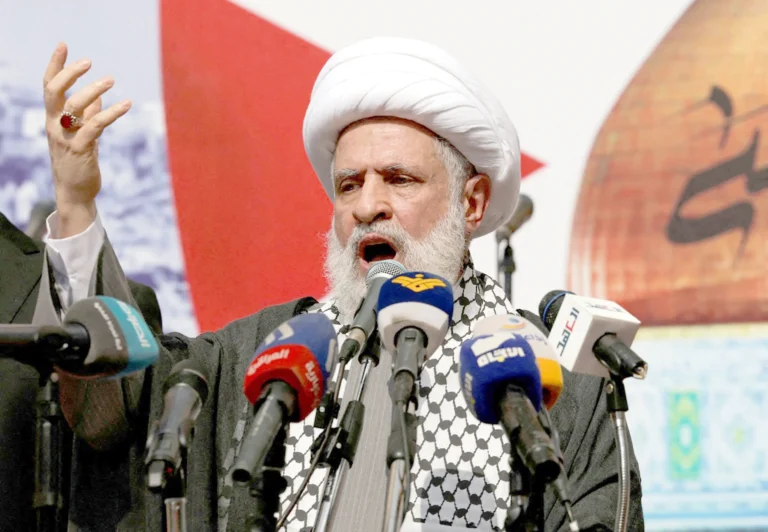
Beirut, Lebanon – Hezbollah Secretary General Naim Qassem said that calls to disarm the resistance represent an “American-Israeli project” aimed, as he put it,
at ending the resistance in Lebanon and opening the door to controlling the country and undermining its sovereignty.
He stressed that “it is not permissible to demand any step from the Lebanese in this direction
at a time when Israel is still occupying Lebanese territory and violating sovereignty by air, sea and land.”
Disarmament… don’t ask anything of us.
In a speech he delivered today, Qassem stressed that “disarmament is not an internal Lebanese demand,
but rather comes in accordance with the American timetable and with clear Israeli objectives.”
He considered that the aim of this proposal was to “annex part of Lebanon,
and turn the other part into a tool that serves American and Israeli interests.”
The Secretary-General of Hezbollah added: “Do not ask anything of us anymore.”
He stressed that the current stage does not impose any additional measures or obligations on Lebanon.
This is before Israel fulfills its obligations, foremost among them being to stop the repeated attacks
and withdraw from the occupied Lebanese territories.
Weakening the resistance and Israel’s superiority
Qassem explained that talking about restricting or disarming weapons
while the occupation and attacks continue “lacks any national or sovereign logic.”
He stressed that the resistance was founded primarily to defend Lebanon,
and that targeting it directly serves Israel’s interests.
It also serves a broader project to dominate Lebanese decision-making.
He considered that the political and media pressure exerted in this matter comes in line with American policies in the region.
That policy aims to “weaken the resistance forces and redraw the balance of power in a way that ensures Israel’s superiority.”
Qassem concluded by emphasizing that any discussion about the future
of Lebanon and its sovereignty must begin with stopping Israeli violations.
And also recognition of Lebanon’s right to defend itself,
He stressed that the resistance would remain, as he described it, “
an element of strength and protection for Lebanon in the face of external ambitions.”