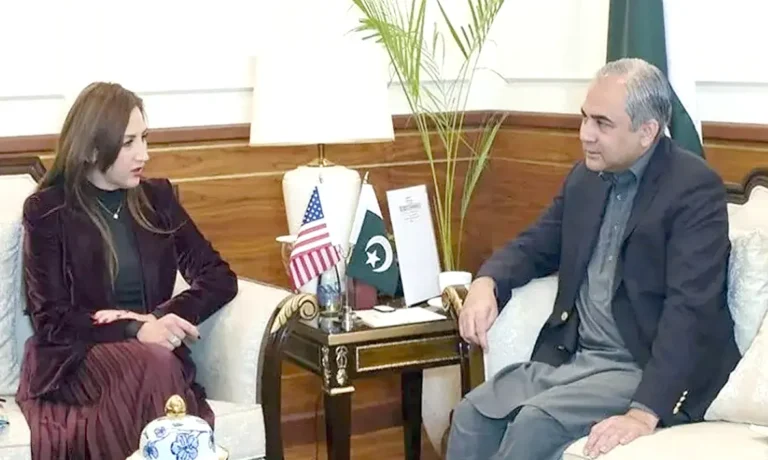
Islamabad, Pakistan – Pakistan and the United States have agreed to intensify bilateral cooperation in the areas of security, counter-narcotics and preventing illegal immigration.
This agreement came during a meeting held in Islamabad
between Pakistani Interior Minister Mohsin Naqvi and the acting US ambassador, Natalie Baker.
Enhancing security and information sharing
The talks between Naqvi and Baker focused on strengthening cooperation
in several key areas, including intelligence sharing:
Working to strengthen information exchange mechanisms to support joint security efforts.
And to reduce drug trafficking, where the US envoy offered to provide
full technical assistance to Pakistan in this area.
Also, expanding the scope of joint measures to stop unauthorized movement across borders.
Baker stressed that identifying drug trafficking cases at airports remains a top priority.
She pointed to the installation of advanced scanning devices in all major airports in the country.
For his part, Minister Naqvi stressed that Pakistan is implementing
a strict policy of zero tolerance for drugs.
He pointed out that drugs coming from Afghanistan reach dozens of countries.
Naqvi welcomed US technical support to enhance his country’s capabilities.
The ambassador was informed that the National Center for Drug Control Coordination
will soon be established under the direction of the Prime Minister.
A shift in the nature of the bilateral relationship
This agreement comes in the context of a broader shift
in the relationship between the two countries.
Both sides are now emphasizing economic cooperation.
This is in addition to traditional security ties, after years of unequal interaction.
Features of the new trend
Both sides reaffirmed their commitment to strengthening bilateral relations in November.
Islamabad’s envoy described this effort as building a “strategic and economically sound partnership”.
US officials have pointed to Pakistan’s potential role in regional stability.
And its ability to contribute to economic and energy initiatives in South and Central Asia.
Pakistan is seeking to diversify its partnership
with the United States away from over-reliance on China.
The Trump administration encouraged American companies to explore
investment opportunities in infrastructure, minerals and technology.
In October, US Secretary of State Marco Rubio said the United States saw
an opportunity to expand its strategic relationship with Pakistan.
He stressed that this would not be at the expense of Washington’s relationship with New Delhi.
Prime Minister Shehbaz Sharif also met with Mr. Trump in September
to discuss regional security and cooperation in combating terrorism.