
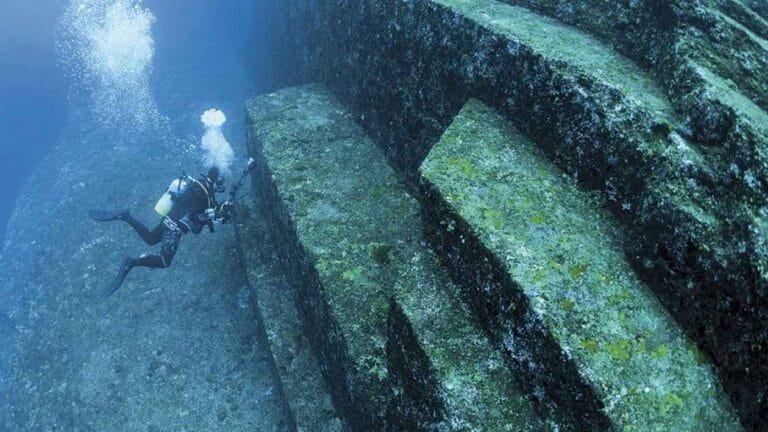
Japan – In a scientific breakthrough that could rewrite the history of civilizations, Japan announced the discovery of a “giant pyramid” deep in the waters off Yonaguni Island. It asserted that the mysterious stone formation predates the Egyptian pyramids of Giza.
According to Japanese scientific reports, divers who discovered the site confirmed that the submerged pyramid features massive stone steps. Furthermore, its precise geometric structure suggests it is man-made rather than a natural formation, as previously believed.
Japanese researchers have suggested that the pyramid may be more than 10,000 years old. This would make it one of the oldest archaeological sites on Earth, if its human origins are indeed confirmed.
The discovery sparked widespread debate in the global archaeological community. This was especially true after the release of images showing stunning details of the submerged structure, leading some scholars to describe the site as “Atlantis of Asia.”
Others, however, urged caution, pointing to the need for thorough studies to determine whether the pyramid is a natural formation or an archaeological creation of a lost civilization that predates the ancient Egyptians by thousands of years.