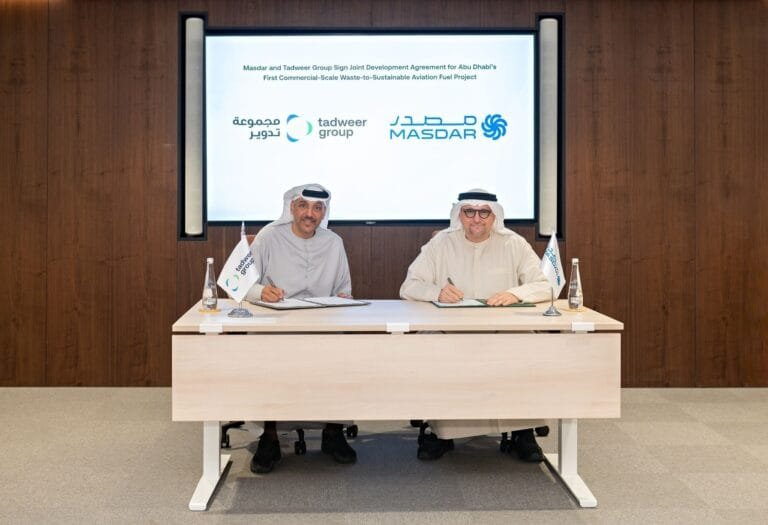
Abu Dhabi, United Arab Emirates – On Thursday, Abu Dhabi Future Energy Company “Masdar” and Durour Group announced the signing of a joint development agreement, under which the two companies will cooperate in developing the first commercial-scale project to convert waste into sustainable aviation fuel in Abu Dhabi.
The station, located in Abu Dhabi, will convert about 500,000 tons of waste annually into sustainable aviation fuel.
Through a hybrid production process that combines the use of renewable energy to perform electrolysis and produce green hydrogen.
In addition to treating waste to extract synthetic gas that is later converted into sustainable aviation fuel using a set of approved chemical processes.
On this occasion, Mohammed Jamil Al Ramhi, CEO of Masdar, said that Masdar is committed to working to accelerate a qualitative shift in the global energy sector by building effective partnerships and providing innovative solutions that meet customer needs.
For his part, Ali Al Dhaheri, Managing Director and CEO of Dorawa Group, said that this agreement constitutes a pivotal step in Dorawa Group’s journey in line with its mission to manage waste efficiently as a valuable resource, to achieve maximum benefit from it, with the possibility of converting it into a major source of energy production.
The project is expected to cover multiple markets upon entry into operation.
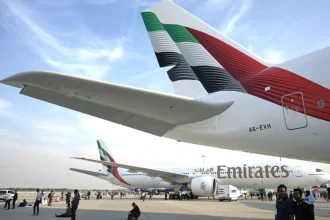
This contributes to making Abu Dhabi a regional center for sustainable aviation fuels, and supports efforts to decarbonize this sector, which contributed more than 18% of the UAE’s gross domestic product in 2023, according to data from the International Air Transport Association.
Sustainable aviation fuel has the potential to reduce carbon emissions during all stages of use by up to 80% compared to traditional aviation fuel.
This is according to a study by the International Air Transport Association.
The project also represents an important step towards achieving many national strategies.
Including the indicative general policy for sustainable aviation fuels, and the Abu Dhabi Low Carbon Hydrogen Policy.
In addition to the National Hydrogen Strategy, the Abu Dhabi Climate Change Strategy, and the UAE Strategic Initiative to achieve climate neutrality by 2050.