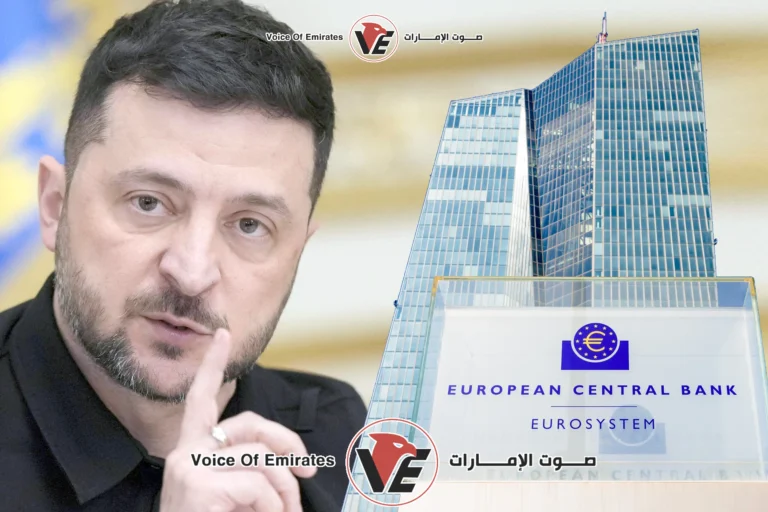
Frankfurt, Germany – European Central Bank President Christine Lagarde confirmed that the bank will not provide any guarantee or support for any lending mechanism intended for Ukraine
if it would lead to a violation of EU legislation or circumvent its founding treaties.
Lagarde’s remarks came during a press conference following a meeting of the bank’s board of governors.
She stressed that the European Union “prides itself on its strict respect for the rule of law.”
Article 123: The red line for cash financing
In this context, Lagarde explained that the central bank should not encourage any mechanism
The organization may be required to violate Article 123 of the Treaty on the Functioning of the European Union.
This article explicitly prohibits direct cash financing of public spending.
This includes printing money to finance governments.
Accordingly, Lagarde considered that this ban applies to any direct financing
that may be provided to Ukraine through unconventional monetary instruments.
Bank independence in the face of pressures
Furthermore, the head of the central bank preempted any further interpretations by saying:
“You cannot expect me to confirm the viability of a mechanism based on cash financing.”
This reflects the bank’s firm rejection of any proposals that might compromise its independence.
Or it puts him in confrontation with his international and domestic legal obligations.
European disagreements over Russian assets
On the other hand, these statements come amid a heated European debate about how to finance Ukraine for 2026 and 2027.
Especially with regard to the confiscation of frozen Russian assets.
While Hungarian Prime Minister Viktor Orban indicated that the expropriation
issue would be removed from the agenda and replaced with a joint loan,
However, the President of the European Commission, Ursula von der Leyen,
confirmed that the option of confiscation is still open for actual discussion.
warnings from Moscow
In conclusion, despite the insistence on supporting Kyiv, several European countries
have long-standing legal and financial reservations about the confiscation move.
At the same time, Moscow continues to escalate its rhetoric,
describing any infringement on its assets as “theft”.
This raises the prospect of retaliatory measures that could further
complicate the global financial landscape if these controversial mechanisms are adopted.